Posts

Showing posts with the label Artificial Intelligence

Has AI Grown Up yet? Debbie Bennett

Image
There are many things in life which polarise people. Off the top of my head, I can think of politics, religion, climate change. Opinions on these things can make or break friendships and other relationships. How many times have I read online: If you vote X, then unfriend me immediately and similar statements. I have friends of all persuasions and their opinions on most things are all part of what makes friendships rich and interesting both online and in real life.  In the online literary world – well, social media anyway – the controversy of the month seems to be artificial intelligence. People come at this from all angles. Some hate any use of AI in any shape or form – it’s stealing, it uses too much water, it’s cheating, and they can go on and on about saving the planet and the livelihoods of every creative persn living on it. Others see it as the future and why shouldn’t they use all the help they can get, they don’t have any money and don’t see any problems.  The reality,...

A Year of Reading: What If? (book vs machine) - reviewed by Katherine Roberts

Image
My reading has taken a slightly different path this autumn, thanks to the rapid development of Artificial Intelligence. Last month, Machines That Think (part of the New Scientist Expert series) rather blew my mind, despite being published 10 years ago. Since then, AIs have become more sophisticated and even more data hungry, resulting in a class action by authors against Anthropic in the US claiming their copyrights were violated. Similar questions are being asked by the music business, as highlighted in a recent Radio 3 programme The Artificial Composer . AI is also active in other creative industries, such as the art world and video games. It seems creative professionals the world over are in danger of being reduced to hobbyists, helping to train the very AI tools that will enable everyone else to become an instant author or composer, visual artist or video game creator. How did this happen without us noticing? Let me take you back to fiction's favourite prompt: What If? and a bo...

A Year of Reading: Machines That Think reviewed by Katherine Roberts

Image
I love the serendipity of allowing random books to arrive in my life from unexpected sources... this month's offering is a non-fiction title picked up from a stall at our local Apple Pie Fair. I went for a slice of the giant apple pie, and came home with rather more to digest than I'd bargained for! 'Machines That Think' is part of a New Scientist series written by multiple human experts in the field. Subtitled 'Everything you need to know about the coming age of Artificial Intelligence', this book practically jumped into my hands. On checking the copyright page, I was rather disturbed to see that it was published in 2017, which is ancient history where technology and AIs are concerned. However, if you study the dawn of computing, it's clear these clever little programs have been around a lot longer than you'd think. The first chatbot (named Eliza, after Eliza Dolittle in the play 'Pygmalion') was developed in 1966 as an artificial psychoanalyst ...

AI See - or Rather, I don't by Neil McGowan

  It’s been a bit of a grumpy month for me. I’ve had the dubious pleasures of AI foisted on me at work, and spent far too long looking for an off switch for it. To be perfectly honest, I’ve never really bought into the hype about AI. I’ve always thought it’s a bit like 3D TV – quite niche, and ultimately not that useful. Because, fundamentally, it’s not really intelligence – it’s just a cleverly programmed algorithm with a vast trove of data to fall back on for pattern matching. I tried to be fair when evaluating it, but gave up after a day when it confidently informed me that the word ‘strawberry’ contained the letter ‘R’ four times, and showed me a picture of a raspberry. It also insisted there were twenty-five years in half a century. Sigh. Despite this, I’ve had a stream of people gushing over it. The most ironic comment was that it would ‘write my emails for me’ – all I had to do was proof read them and correct them… Suggesting it would be as quick to just writ...

Artificially Intelligent or Intelligently Artificial? by Debbie Bennett

Image
(c) Mikko Paananen, CC BY-SA 4.0 https://creativecommons.org/licenses/by-sa/4.0, via Wikimedia Commons AI. Artificial Intelligence. I’m sure there have been many posts here and elsewhere on this topic as we all become more and more outraged about how the machines are taking over the world. People are polarised in opinion – either it frees us all to be artists, or Skynet is on the horizon and before we know it, Arnie will be hunting us down!  Actually, the first thing I think of when I hear the term is the film A.I. Artificial Intelligence . A hauntingly beautiful modern retelling of Pinocchio where a little robot longs to be a real human boy. I love this film. But then I have fond childhood memories of a beautifully-illustrated hardback book of the Pinocchio story and used to dress up as the Blue Fairy when I was little! But AI in writing is a relatively recent thing. I suspect it’s been around for years, quietly scraping content from the internet without our knowledge or permissio...

AI generated biography of children's author Katherine Roberts - by ChatGPT with comments by Katherine Roberts

Image
AI-generated image of Katherine Roberts by media.io Katherine: Write a bio for children's author Katherine Roberts. ChatGPT Title: Katherine Roberts - Enchanting Worlds and Magical Words Introduction: Step into a world where magic dances through the pages and adventures await around every corner – that's the enchanting realm created by the beloved children's author, Katherine Roberts. With her boundless imagination and gift for storytelling, Katherine has woven tales that transport young readers to wondrous lands and spark their own creativity. Katherine: I’m rather enjoying it so far :-) ChatGPT Early Beginnings: Born with a twinkle of magic in her eyes, Katherine Roberts grew up in a charming village nestled between rolling hills and whispering woods. As a child, she was a curious explorer, always seeking hidden treasures in her backyard and weaving stories about the mystical creatures that might inhabit them. Little did she know that these childhood adventures would lay ...

AI, or not AI? by Neil McGowan

The last few weeks have been a hectic mess. I’ve not been writing as much as I’ve been too busy dealing with the vagaries of real life, but did manage to revisit an idea I’d sketched out some years ago. The seeds of this story hark back around seven or eight years, and were planted when I heard Professor Stephen Hawking talking about the dangers of artificial intelligence. (Having seen the output of most of the machine learning models so far, I think there’s quite a way to go yet; I usually refer to it as ‘artificial idiocy’ – yes, I’m a curmudgeonly old technology sceptic – as most of the time it seems too easy to find faults either in the system itself, or the training data used ; you don’t have to look far to find stories illustrating how biased facial recognition systems can be, for example.) Over the next few days, there was a raft of stories across various media, either proclaiming AI as the salvation of humanity, or the beginning of the end. But one thing struck ...

Why the writing process is a mystery by Amy Arora

Image
I recently started writing short stories for the Reedsy Prompts weekly contest . This is a fantastic competition for kickstarting your writing if/when you feel blocked. The prompts are always thought-provoking with great scope for exploration. The best part is that you get to read the other stories submitted to the contest once the winners are announced. Exploring hundreds of different ways to interpret the same prompt is a wonderful testament to human creativity, as well as reassurance that AI is not going to steal all of our jobs just yet.  In all my years of entering writing competitions, I’ve never won a single thing. I don’t take it to heart. It’s a writer-eat-writer world out there (I’m kidding—I love learning from other writers. I’m also a vegetarian and not a cannibal). But in all seriousness, I enter these contests not with a hope of victory, but with the knowledge that it’s a great way to improve my craft.  Well, dear reader, guess what? The very first story I entere...

AI meets Dunning-Kruger -- Susan Price

Image
Enginesoptional, Redbubble, 'We Fall Only To Rise.' Long-sleeved t-shirt   Earlier this month, my AE colleague Debbie Bennett posted an amusing (but saddening) blog about the threat posed to writers by the many people, in Debbie's words, 'upload[ing] thousands of low content bits of tat a day' . Much of the tat clumsily ripped off from others. Ripped off from us . As Amazon's bots and human staff check everything uploaded for copyright infringement and other crimes, the rise in low-content tat means that it takes longer for all books published through them to be approved: so the shameless intellectual theft of a few makes indie publishing harder for us all, even when our material is legit. I was reminded of another threat to all us hard-working, and mostly under-paid, writers and artists: the much vaunted AI or Artificial Intelligence. One of my brothers told me about a Polish fantasy artist named Greg Rutkowski who, it seems, is being persecuted and ripped ...

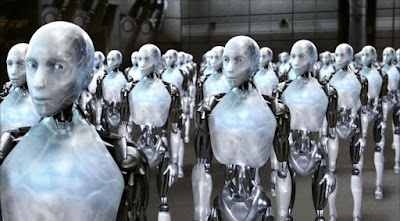
When your tech is smarter than you... by Katherine Roberts

Image
scene from 'I, Robot'  © 2004 Twentieth Century Fox. One of humanity's greatest fears is that intelligent machines will take over the world and enslave us as human beings. Science fiction has already been there, done that and got the robo-t-shirt. In the Terminator films, Arnold Schwarzenegger plays a cyborg assassin sent back through time to kill the one human who might be able to stop the machines. Whereas in  I, Robot,  based on a collection of short stories by Isaac Asimov, every robot is programmed with three basic laws designed to keep it subservient to humans: 1. A robot may not injure a human being or (through inaction) allow a human being to come to harm. 2. A robot must obey orders given to it by human beings, except where such orders would conflict with the First Law. 3. A robot must protect its own existence as long as such protection does not conflict with the First or Second Law.   We might not (yet) have rampaging Terminator-style machines tearing up ...