Posts

From the Reluctant Writer... Mari Howard (Clare Weiner)

Image
Desk and tools! Some writers say ‘I always wanted to write’ and they can point to reading out to the class a story they had written, aged about six. My stories were always drawings, but always ‘narrative’ drawings, as the A-level art teacher described them. Writing, as such, evolved much later, after school, after university.   My stories come straight from my interest in people, their motivations, their underlying cultural beliefs, what they want from life. School is a microcosm of society and it’s where aged five, I first realised the enormous differences between me and the other children. Why, for example, do some kids bunch together as a group in the Wendy House, and then disallow any others to join them? It seems some of us arrive at   school to discover we attended the “wrong” nursery! What makes kids think “us and you” style? Why does someone come behind and pinch you, or kick you under the table in class? So, I became fascinated by people and observed them, trying to f...
Authors, Celebrity Authors, and AI - Katherine Roberts

Image
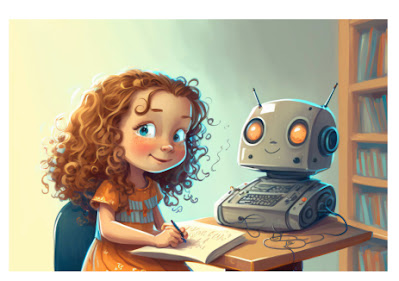
Illustration from 'Alice and Sparkle' by... ??? Who   wrote that latest celebrity title piled high in every bookshop? And why does it matter? In his article 'Star Power' ( The Author,  spring 2023), Irish writer and illustrator Oisin McGann warns that celebrity books are in danger of taking over children's fiction. Experienced authors like him are often employed to ghostwrite such books, or at best collaborate with the celebrity, and yet their contribution is sometimes not even acknowledged; they simply get paid a fee for their work. You might think this is fine. Both authors - celebrity and ghostwriter - get paid. The celebrity gets their name featured prominently on the cover, the publisher gets a book they can sell easily, bookshops are delighted since they get commission on every sale, and the young reader gets a decent enough book for their money. Everyone is happy, everyone wins. But where is this heading? I'm old enough to remember when children's boo...

Celebrating Charlotte Haptie by Sandra Horn

Image
Granny Grabbers by Charlotte Haptie There are many reasons for writing, but perhaps the most important (and only legitimate?) one is joy. The joy of creating the story, the poem, the essay from your own store of words. The joy of knowing that the work is as you want it to be, the pattern of the words has fallen right, the arc of the narrative is pleasingly as you planned. There’s nothing else like that feeling. From time to time, someone unearths a notebook or diary from a forgotten cupboard or box in the attic, and discovers a treasure, the writings of someone, perhaps long gone, never meant for publication – created for the joy of creating. For most of us, however, the next step in the creating is to share it, and to that end, we enter the devious and dangerous world of publishing, without even a ‘Beware of Crocodiles’ sign to guide us. From time to time, someone I do not know, or know slightly, or is the friend of a friend, says the dreaded words, ‘I’ve written/my mother-in-law...

Holiday Writing by Allison Symes

Image
Image Credit:  Images created in Book Brush using Pixabay photos. Do you write anything connected to holidays, whether they’re ones you’ve taken, or ones where you've sent your characters away? I don’t though I can see the appeal. You’ve got the chance to put your characters out of their normal environment. How would that change their behaviour and attitudes? What would be the consequences? I’m thinking about Death on the Nile by Agatha Christie here. What was supposed to be a honeymoon trip became something different. How could you make use of holidays you’ve taken to enhance your stories? One idea is to use the landscape of where you’ve visited as a model for the setting for your story.  I was in lovely Northumberland last autumn and was staying near a lovely town with a gorgeous river running through it. So I could take that idea and fictionalise it for my story or I could take certain elements only and put those in my tale. Holiday photos can also inspire ideas later. Lan...

From Mrs Tiggy-Winkle to Spiny Norman by Elizabeth Kay

Image
 Hedgehogs are part of British culture, and are so distinctive that they have figured in our literature for a long time. They are in serious decline in the UK these days, thanks to road kill and pesticides, so I was thrilled when I set up the camera trap to see if foxes were digging up our Jerusalem artichokes and discovered a hedgehog bustling past instead. The artichokes are fine, by the way, just a bit slow to emerge, and are now three foot tall. Since then we reckon we have spotted five different individuals, thanks to Brambles Crunchy Hedgehog Food , which is very popular, and makes their munching audible halfway down the garden when they arrive for their breakfast – 21.30 at the moment. Bread and milk, the traditional offering, is very bad for them, and cat biscuits make another acceptable and safe alternative. They are incredibly entertaining, as they have no compunction about shoving competitors for their lady friends out of the way, and have very noisy and lengthy wooing s...

The First Line by Wendy H Jones

Image
  ‘In today's competitive market a writer needs to capture their reader in the first paragraph if not the first line. Susan May Warren In today's climate of instant media and gratification, the author has only a few seconds to grab a reader's attention before they move on. Modern consumers are used to making an assessment and scrolling on if what they see or read does not interest them. Therefore, the opening to a book must hoo k the reader and pull them in, tantalise them and invite them to keep reading. It should set the tone and voice of the whole novel . Sara Ridley suggests six components of what a first line can do to make your reader move on.  Conflict Question Emotional Connection Humour Shock  Twist The types of opening lines are outlined as  Action Character Setting Thought Statement World building Of course, your first line can be a mixture of all of the above, although I would suggest you try not to pack too much into it or the opening may just become con...

Power Shagging: Oscar and Walt's Bedtime Boogie--by Reb MacRath

Image
  Walt Whitman never had a chance. Older artists seldom do when slathered with praise by ambitious wannabes eager to trade sex for favors.  Oscar Wilde sailed from London on 12/14/1881 and arrived in New York on 01/02/1882 at a high point in his career, not only famous but moneyed. In the next ten months he would cross and recross the U.S. to deliver 150 lectures heard by tens of thousands of Americans. All of this was according to plan. But so far one big piece hadn't fallen into place: he had to meet the old poet whose uncensored Leaves of Grass was known only in England to those who'd scored bootlegged copies. (The British 'comely edition' deleted half the contents of the American 1867 edition.) Upon receipt of an invitation to meet, Wilde raced from a Philadelphia lecture to his hero's place in Camden, New Jersey on 01/18/1882.                                           ...