Posts

Too Many Endings (Cecilia Peartree)

Image
As I write this, we have not quite reached the end of the year, and on this morning of 30th December I've just completed the first draft of the novel I've been working on and also the final version of the family history research write-up I've planned to do for a couple of years. There is something unsettling about having finished both these projects at almost the same time, and I have a terrifying vision of the next year stretching out ahead of me as a blank canvas, or a stretch of fresh snow, just fallen and untrodden by any human foot. This has been a whole year of endings. My mother-in-law died in Februrary at an advanced age after a good deal of illness, and my husband died in November, somewhat more unexpectedly but after eighteen months or so of poor health.  I suppose only a writer could compare the blankness of the end of a project to the blankness of losing someone who had been part of her life for the best part of fifty years, but I've found it rather similar....

Starting at 'the end of the road... ' - Umberto Tosi

Image
Jobim, 1981 Águas de Março, Tom Jobim's poetic, meditative, 1971 Bossa Nova gem celebrating southern Brazil's rainy month of March, has been playing in my head as we free-fall into 2021. Back in the 1980s, I memorized the lyrics so I could strum to it with my Goya, Spanish guitar. The song - about endings, beginnings and timeless flow, Zen and the beauty of common things - helped me through a rough patch. I can neither recite nor strum it from memory now, as this new year begins in which we all hope to emerge from a rough patch. But it's there, still flowing. "A stick, a stone, it's the end of the road It's the rest of a stump, it's a little alone It's a sliver of glass, it is life, it's the sun It is night, it is death, it's a trap, it's a gun The oak when it blooms, a fox in the brush A knot in the wood, the song of a thrush... ... It's the wind blowing free, it's the end of the slope"  - The Waters of March , Antonio Carlos ...

Dealing with the Dog -- Peter Leyland

Image
          Dealing with the Dog, a meditation on using literature to help us feel better   The idea of using literature as a support in times of trouble is not a new one. The philosopher Montaigne after the death of his friend from the plague in the C16 spoke of the companionship of books and there are indeed many studies of how this works. It has even been given a label,  bibliotherapy  and I have presented a number of papers on the subject at adult education conferences over the last few years. These papers were not particularly academic but rather autoethnographic and to save you looking that up it is a research method where a writer uses self-reflection to explore personal experience and to connect this to wider cultural, political and social meanings.   So here goes. Some time ago when I was in the depths of despair following a marital breakup, not so unusual now but in those days difficult particularly for men who were unable to share th...

The clever joke I wish I'd made. Oh wait... -- Griselda Heppel

Image
Back in 2015, somebody made a clever joke that I wished -   a) I’d thought of myself (naturally)   b) the person had made it five years before, giving us so much longer to enjoy it.   It went something like this:   Prospective employer : So, Ms ------, where do you see yourself in five years’ time?    Interview candidate : I don’t know. I don’t have 2020 vision.   No 2020 vision here Photo by  Ksenia Chernaya  from  Pexels With 2020 behind us, that joke has taken on a kind of tragic grandeur, of Socratic irony even. Nobody had 2020 vision. E xcept for a few far-sighted scientists and medical experts who knew we were in for a pandemic but couldn’t say when. And if they had pointed to 2020, who’d have believed them? Yes, yes, we’d have said. Don’t worry, we’re used to flu. We’ll be fine.  A wonderful thing, hindsight. By the time you read this, we’ll all have 2020 vision. Just, er, backwards.  Spectacular sour...

Hanging on: N M Browne

Image
 So, this blog was going to be the sad end of year reflection on a year of Covid, of the last year in which all of Europe was still  ours to explore at will. I went to Paris at the end of February as the world woke up to virus and I went to Venice post Covid in the early summer when, briefly, the world opened up again: memories to hold on to.  This year has been about hanging on. I wrote a poem everyday through lockdown - hanging on to creativity and small pleasures: the birdsong in the garden, sunlight striping the floor, walks with a friend and wine -  probably too much wine. This year has been about hanging on to connections, contriving safe ways to meet family and friends. We hung on to Christmas by having it outdoors in November in a festive gazebo. I have decided to hang on to  59, though my transition into young old age was marked memorably and well with a walk in the park and champagne, I think I'll celebrate it again next year - when I may be able to se...

Goodbye, Enid from the Authors Electric

Image
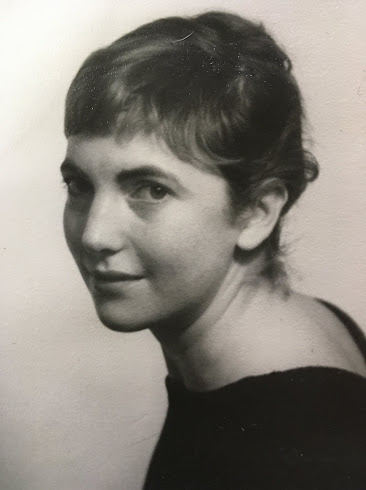
  Enid Richemont For many years the 28th of each month has been the day when Enid Richemont blogged for Authors Electric -- usually in the form of a diary entry, with news of her books -- which covered a wide field -- or proudly writing of her daughter's theatre career. Sadly, there will be no more diary entries from Enid. In the late months of 2020 Authors Electric learned, first, that Enid had been diagnosed with cancer -- and then, all too quickly, that she was very ill and had died. We feel her loss. Enid was born and grew up in South Wales but spent most of her life in north London. Her marriage to David Richemont was a long and happy one and they raised two children.   Enid and David   Enid won a scholarship to Dublin's College of Art, where she studied painting and design; and she taught in a Rudolf Steiner school. Together with her family, she lived for two years in Paris. She wrote for both adults and children and her work has been translated into Danish, German,...

Becoming a Period Piece in Just 20 Years -- Andrew Crofts

Image
  Time is speeding up. A novel I wrote twenty years ago is being republished by Lume Books. It is called “Pretty Little Packages”, (although it started life as “Maisie’s Amazing Maids”). The main character is a ghostwriter, (no surprise there), and the plot is about modern slavery, which was a subject I was writing about a lot at the time. Re-reading it now, nothing much has changed about the modern slavery business – if anything it has grown worse, but perhaps we are just more aware of it than we were at the turn of the Millennium. A lot of other things, however, have changed.  I n the year 2000 mobile phones still had a certain novelty value for many of us. Most of us certainly didn’t use them for anything other than phoning one another in the age-old manner. Letters still came through the post, we bought street maps when we had to navigate around unfamiliar cities, and fax machines were commonplace.   Full body tattoos were highly unusual and when one of the char...