Posts

Showing posts with the label digital publishing

Ambitious Horse Books by Katherine Roberts

Image
Twenty years ago, I wrote a rather long novel about Alexander the Great from the point of view of his famous warhorse Bucephalus. At the time, I had a brilliant children's publisher (Chicken House) keen to publish my book in hardcover for the 10+ market who already enjoyed my fantasy novels. Unfortunately, bookshops did not share the same view and rejected the hardcover, so publication was delayed while a more suitable format was found for the book that would please everyone - which, as everyone knows, is impossible. In the end, "I am the Great Horse" (edited down from its original 200,000 words to a modest 150,000) enjoyed its scheduled hardcover publication in the US with Chicken House's partner Scholastic, and hit the UK shelves a year later than planned in paperback. Having missed its publicity slot over here, it sold averagely. Or perhaps my novel, being rather long, historical and written by a horse , was just too quirky for the children's market? Anyway, t...
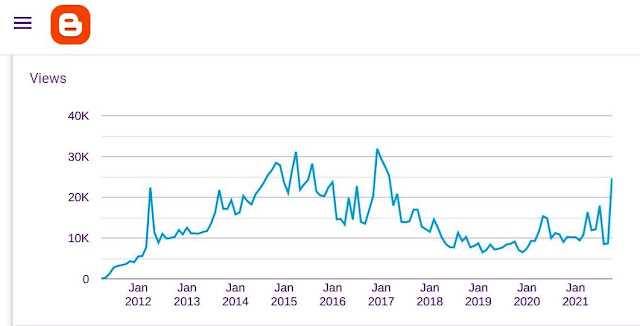
Authors Electric, 10 years and counting... Katherine Roberts, Susan Price, Debbie Bennett

Image
Amazingly, this year is Authors Electric’s 10th anniversary (the picture is a screenshot of our all-time page views). A huge thank you to everyone who has been with us over the years, past and current bloggers and our lovely readers - we would not exist without you! For our tenth anniversary post, we thought we’d get our three founding members together to bring you this glimpse of a distant past, when ebooks were a rude word as far as our publishers were concerned. Please welcome to the virtual stage Katherine Roberts, Susan Price and Debbie Bennett. *polite clapping and a couple of wolf whistles* KATHERINE: It all started in 2011 at a secret location in deepest Oxfordshire, where two prize-winning authors got chatting about their books going out of print and the general state of the publishing industry. SUE: I think both of us arrived early for the Scattered Authors’ conference at Charney Manor. So we sat in the sunny garden, with swifts screaming in squadrons from the chimney pots to...

The Goldilocks Curve - Umberto Tosi

Image
What we can do now seemed like an impossible dream twenty years ago when I first became involved with direct, digital publishing. Yet, as an indie writer in the midst of reading another book for release, I've gone from being awed by the digital tools at my disposal to feeling frustrated with their limitations. How fickle and ungrateful can we creative types get? By the late 1990s, publishers for which I had worked had been using digital technology for almost a decade - eg., word processing, and desktop publishing. But the process had remained industrial - requiring costly, professional software, high-speed printing presses, and distribution channels that requred sizeable, although diminishing, capitalization that was out of the reach for most writers -- even successful ones. As always, futurist predictions aside, everyone in the business assumed that the status quo would be a forever thing -- even those running the high-tech business magazines for which I freelanced interviews...

The Summer Solstice of Publishing - Katherine Roberts

Image
It's midsummer, although you wouldn't know it from the weather as I write this (Spain is apparently sending us storms). So rather than yet another summer solstice blog post, I've been thinking about where we might be if you view the publishing industry as a single year. It goes something like this: JANUARY: Stone Age ~ 40,000 - 10,000 BC We live in caves. People tell stories around the campfire at night. Nobody writes them down but somebody might illustrate the most exciting ones on the cave walls. (January is a long, dark month.) telling stories around the campfire (Emeldil, CC*) FEBRUARY: Pyramid Age ~ 4,000 - 2,500 BC Europeans are still living in caves, but in Egypt they are building pyramids. Priests decorate the walls of their temples with religious texts in hieroglyphs, while further east in Mesopotamia people are writing similar texts on clay tablets using a clever pen-press language called cuneiform. Bestseller: The Book of Coming Forth by Day (Ancient...

On Becoming a Born Again Virgin--Reb MacRath

This summary is not available. Please click here to view the post.

When Well Enough is Best Left Well Alone; or, Confessions of a Serial Rewriter - Mari Biella

Image
One of my major problems in life is that I’m rarely satisfied. Nothing is ever really big enough, exciting enough, or good enough for my liking. Far from being the motivating factor that some might think, this is in fact something of a curse. Whoever said that the key to a happy life was having low expectations was absolutely right. This perfectionism is never more pronounced than in my writing. Frankly, the things I write are never good enough. There’s a sense, of course, in which this is an advantage; I’d never hit that “Publish” button unless I was absolutely satisfied that the work in question represented my best effort. There is, however, a downside. If you hold to the principle that perfection is unattainable in this life, then revision and rewriting are, theoretically, infinite tasks. It could always be better in some way. There is, therefore, a danger that you might spend years – decades, perhaps – going over the same ground, trying desperately to get it just righ...

A New Breath of Life by Ruby Barnes

Image
About five years ago the depressing odds of mainstream publication were clearly explained to me (the following “facts and figures” are plucked from memory and this was just before the real advent of e-publishing). If your submission letter to a literary agent is one of the handful picked out of several thousand they receive each year, if your manuscript is considered worth taking on, if the agent manages to secure a publishing deal, then any advance you will receive from the publisher will be unlikely to run to more than a few grand (unless you’re the Next Big Thing!) Writing novels isn’t a get rich quick scheme. Don’t give up the day job (so say people who’ve read my books). When a new title hits the shelves it has a few weeks to make an impact and a share of the sales proceeds will be offset against your advance. If the book stops selling before the advance is paid off then it will have failed to earn out and that’s the end of the road for that book. Bookshops will...