Posts

Showing posts with the label Vera Rich

Writing about bereavement , by Elizabeth Kay

Image
  Pinky and Perky We’ve had a pair of pigeons that made our garden their home. They were easy to identify, as one of them had particularly pink feathers, and was inseparable from another one with standard rock pigeon colouring. Pinky and Perky. I only realised that it was the pink one that was the male when he made overtures to another pigeon of exactly the same colouring as his mate, and was thoroughly duffed up as a consequence. He remedied his mistake later, by consummating his marriage very publicly on a neighbouring rooftop. Pigeons mate for life, although they may take another mate if one of them dies. And then Perky disappeared. Pinky seemed completely lost, spending a lot of time sitting in the water bowl and scanning the rooftops. We really felt for him, as he was off his food and couldn’t even be bothered to preen himself. This got me thinking about grief, and how bereavement has affected me over the years. And how well do writers describe it? Not very honestly on the who...

I do like being given a challenge - Elizabeth Kay

Image
Manifold Magazine folded many years ago on the death of its editor, Vera Rich. In each edition she would propose two challenges, one subject related, and the other to be written in a specific poetic form. I really looked forward to these – they were terrific stimuli to write something that might well get published. The Spectator performs a similar function, sometimes 150 words of prose sometimes a poem, 16 lines maximum. I only discovered these competitions a year ago; they kick-started me, and I’ve had several published. But near-misses also get a mention, so I thought I’d give some of them an airing here. Blissfully ignoring – something you dislike about your loved one The distinctive call of an eider duck Plus the sound of an airbed deflating Or the distant growl of the M25 Then the huffing of two hedgehogs mating. A grunt that trails off to a whistle is next, Then a silence, a false dawn of hope – But it never lasts long, and the snuffles resume, The top of that ...

In memory of Manifold Magazine, and Vera Rich – by Elizabeth Kay

Image
  Vera Rich was one of those extraordinary people who was a total one-off. Clever, funny, infuriating, multi-lingual and fiercely in favour of an independent Ukraine, she was a part of my life for fourteen years. She was revered in Ukraine and Belarus for her poetry translations, and I travelled to Ukraine with her on two occasions. Vera never needed to embellish stories – her life had been quite exciting enough. She edited the unique Manifold Magazine, and I remember her saying, oh yes, people who’d had a week’s holiday in Prague would send me poems about their extensive knowledge of the place. I spent a week in Prague hiding from the Secret Police in a circus… And then there was the time, after Poland was once again a free country, when they saw a police car broken down by the side of the road and stopped to help. The driver kept staring at Vera, until she asked him if he knew her. He stood up very straight, clicked his heels and said, “I had the honour to interrogate you in 1...

Maps, Family Trees and Timelines, by Elizabeth Kay

Image
 Ever been writing something, and suddenly realised you have no idea how to get from A to B? In fact, you have very little idea of what A and B actually look like apart from a few important details such as the pub, the flooded quarry and the cave in which the escaped tiger is hiding. Which direction you would choose? What you would have to pass through/over/under? How long would it take? What method of transport would you use? Or do you suddenly realise that C couldn’t possibly be related to D without some very unlikely incest, or that E and F would never speak the same language or be old enough to have met Stalin? We tend to think we understand the worlds we create so well that we don’t need any help to remember the details, but you can get it so wrong. Even a well-respected author such as C.S.Lewis can create anachronisms, especially when you have two worlds where time moves differently. What really upset me as a child was the time discrepancy between The Voyage of the Dawn Tread...

Memories of Ukraine – by Elizabeth Kay

Image
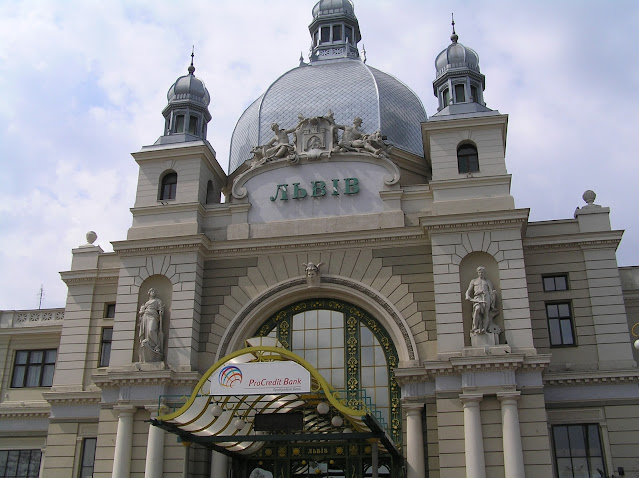
   Lviv Railway Station, an exit to safety for thousands As I am having an operation on my wrist I am writing this post some time in advance, because I won’t be able to type for a while. I thought I would devote it to my memories of Ukraine, as I attended a poetry event at the Ivan Franko University in 2006, and a children’s writing conference in Lviv in 2007.   My father was born not far from Lviv in 1900, and considered Lviv (Lwow as it then was) to be Polish. Ukraine, like Poland, has changed hands many times in the past. However, when it comes to Russia the two countries are 100% united, and recently Poland has been helping Ukraine as much as it can. I was brought up to regard Russia with grave suspicion. I remember at infant school (I must have been six) going up to the teachers for some spellings when we were all writing about what we did at the weekend. The boy in front of me wanted to know how to spell banana. I needed to know how to spell Khrushchev and Bulgani...

The Problems of Updating and Translation, by Elizabeth Kay

Image
These days, we can all update our online books, and customers will get the newest version free of charge. However, when do you do it? Those writing for young people probably have the hardest job, as slang changes year on year, and you can sound like the fustiest old has-been very quickly and a laughing-stock amongst the super-trendy. Do people still use the word trendy anyway? The other big issues are contemporary settings (remember when mobile phones looked like bricks?) and scientific discoveries. When I was a kid, no one thought for a moment that dinosaurs had feathers, or that women guards on the Underground should be paid the same as men.    Climate change is going to present even more problems, I suspect. I haven’t actually updated any of my books, as I’ve always been very careful to make the date in which they’re set a bit ambiguous. This means stating that something costs the same as a four bedroom house in Surrey, rather than the £60,000 it would have cost thir...

Basing Characters on Real People, by Elizabeth Kay

Image
Some characters seem to spring out of thin air, but others have a starting point with a real person. Eccentric people provide the best material – they’re more interesting, their reactions are more exaggerated, they often have a hobby or obsession that informs everything they do. Because of this warts-and-all element, you are unlikely to provide the most flattering of portrayals, and so a name-change is needed. You can, of course, go a lot further, and alter the age, gender and appearance as well. However, the person you know better than anyone else is, of course, yourself - so you use aspects of yourself quite a lot as well. I also think there’s a lot of acting in writing. I imagine myself as my characters, and try to see things from their point of view. This can suddenly give you a completely new insight into someone you thought you knew extremely well. It’s also true that when you know someone very well you tend to assume that the reader knows what they look like too, and it’s eas...

Virtual Reality Versus the Book, by Elizabeth Kay

Image
  I nearly always watch the technology programme Click on a Sunday morning, and the episode that dealt with 360 ˚ cameras really got me thinking. There was a shot of someone strapped into a chair that tilted in every direction, mimicking what was occurring in the presentation where you could look around you, just as though you were turning round or moving your head. This guy’s chair had tipped right forward, and he looked as though he were throwing up. Whatever he was experiencing was all too real. Or was it?             It’s been bothering me for some time, this move to an alternative world. We get our natural history in exotic locations via a screen, edited and selected with its stunning visuals and recorded birdsong and absence of mosquito bites and tummy bugs. There’s nothing to discover – it’s all been done for you, and the sensory experience narrowed to sight and sound alone. A walk in the countryside is so diffe...